
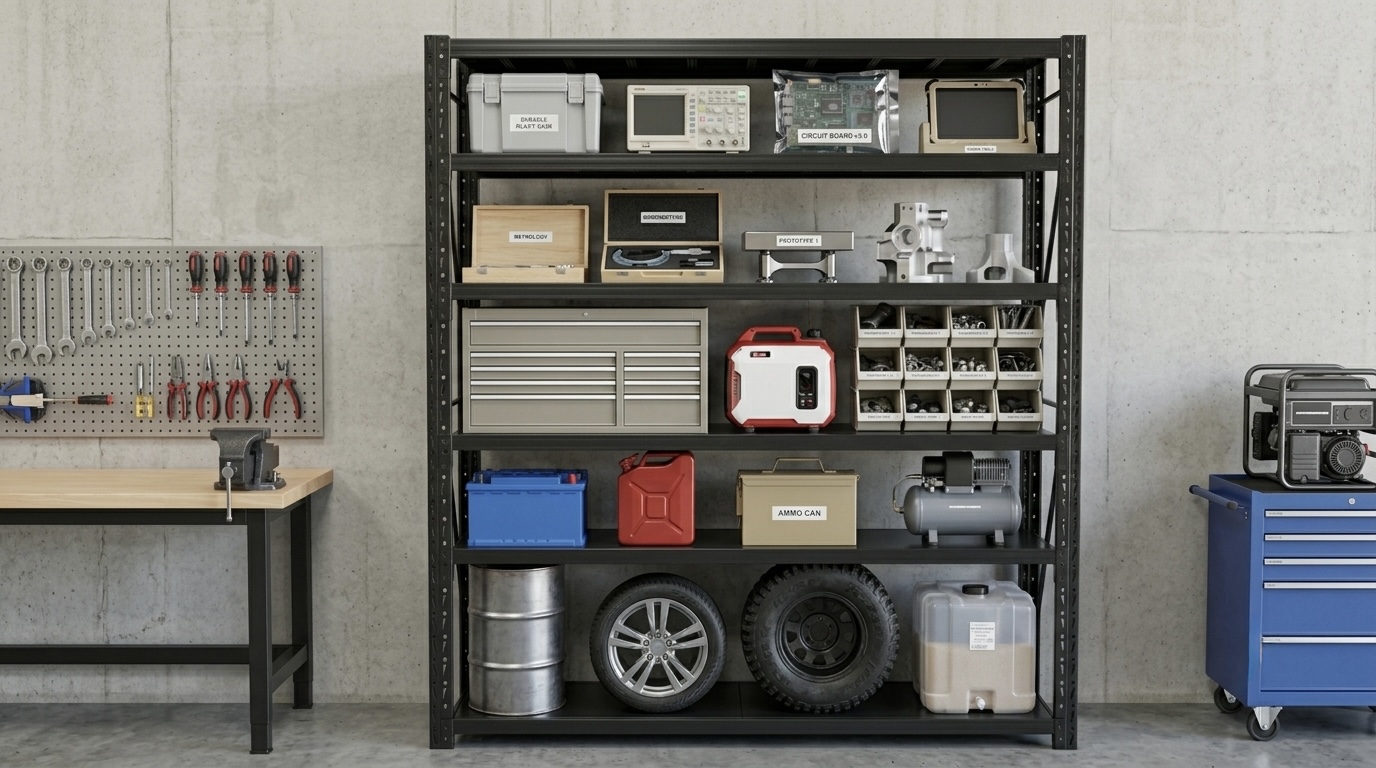
I still remember a customer telling us about the day his old garage shelf gave way. He had a generator on the bottom, four boxes of tiles in the middle and a stack of paint tins up top, and the whole thing folded inwards like a cardboard box in the rain. Nobody got hurt, thankfully, but he lost a fair bit of gear and spent his Saturday cleaning up the mess instead of finishing the job he was actually meant to be doing. It is one of those stories we hear more often than you would think, and it always comes back to the same root cause. People assume shelving can hold whatever they throw at it, right up until it can’t.
So ADS Shelving Solutions actually answers the question properly, because it deserves a proper answer rather than a vague “it depends” from a salesperson trying to get you off the phone.
The Question Everyone With a Full Garage Eventually Asks
At some point almost everyone with a garage, shed or workshop starts stacking things higher than they probably should. It happens slowly. A shelf that started out with a few paint cans ends up holding car parts, camping gear, tool boxes and whatever else needed a home. The shelving itself never changes, but the load on it keeps climbing. Eventually someone asks the obvious question. How much can this thing actually take before something gives?
The honest answer is that it depends entirely on what the shelving was built for in the first place. A flimsy wire rack from a discount store might handle thirty or forty kilograms per shelf if you are lucky. A properly built steel unit designed for serious use is a different animal altogether. Our own heavy duty shelving is rated to hold up to eight hundred kilograms per shelf when loaded evenly, which is roughly the weight of a small car. That is the kind of number that actually means something when you are storing tools, stock or equipment that have real value and real weight behind it.
What Heavy Duty Actually Means in Steel Shelving
The term heavy duty gets thrown around a lot in retail, and honestly it has lost some meaning because of it. In steel shelving terms, heavy duty should refer to the gauge and thickness of the steel used in the frame and shelf panels, the strength of the welds or connection points, and the way the unit distributes weight down through its legs into the floor. Thin, lightweight steel might look similar in a photo, but it flexes and bows under real weight, especially over time as the load sits there day after day.
A genuinely heavy duty unit uses thicker gauge steel throughout, has reinforced bracing between the legs, and is either fully welded or uses a boltless design that locks together under tension rather than relying on a handful of screws to hold the whole structure together. That difference in construction is exactly why one shelf can hold one hundred kilograms and another can comfortably carry eight times that amount.
Why the Bottom Shelf Isn’t the Same as the Top Shelf
Here is something a lot of people don’t think about until it is pointed out to them. Every shelf level on a unit has its own rated capacity, but the legs and frame underneath are carrying the combined weight of everything stacked above that point. So if you load up every shelf to its individual maximum, the legs at the bottom of the unit need to be strong enough to support the full combined total, not just one shelf’s worth.
This is exactly why cheap shelving often fails from the bottom up rather than the top down. The legs buckle, the frame twists, and the whole unit leans before it eventually collapses. A well built unit accounts for this in its overall design so the whole structure works together rather than each shelf being an island on its own.
Garage, Shed or Warehouse: The Load Test Looks Different Everywhere
The weight question changes depending on where the shelving is actually going, because the demands are genuinely different in each setting.
In the Garage
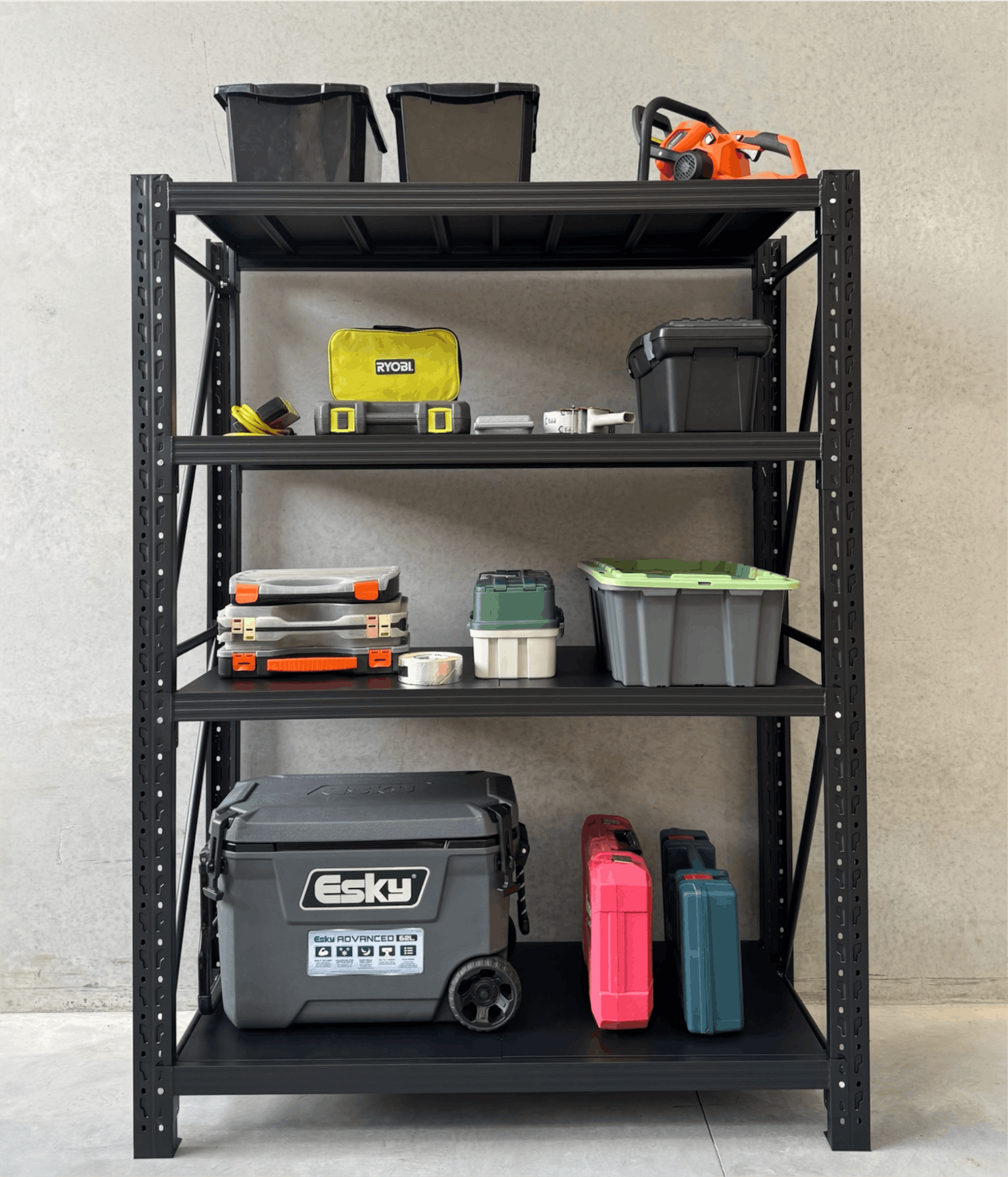
Home garages usually deal with a mix of everything. Power tools, tyres, camping equipment, boxes from the last move that never got unpacked, maybe a lawn mower or a generator down the bottom. The loads are often uneven and irregular in shape, which puts more stress on the garage shelving itself rather than a clean, flat load. This is where a properly rated unit earns its keep, because it can absorb that irregular weight distribution without bowing.
In the Shed
Sheds cop a different kind of punishment. Moisture, temperature swings and dust are constant factors, and the shed shelving inside often holds a similar mix of tools and stock as a garage but in a less controlled environment. Rust resistant coatings and solid construction matter just as much as raw weight rating out here, because a unit that corrodes over time will lose strength long before it ever hits its stated capacity.
In the Warehouse
Warehouses is where weight capacity really gets tested, day in and day out. Pallets, stock boxes, spare parts and inventory get moved on and off shelving constantly, and the units are usually loaded far closer to their actual maximum than in a home setting. If you are managing a warehouse, our range of Warehouse Shelving is built specifically for this kind of high volume, repeated use, with load ratings that hold up under constant handling rather than just looking good on a spec sheet.
Signs Your Current Shelving Isn’t Cut Out for the Job
There are a few signs that a shelf has reached, or passed, what it was ever meant to carry. A shelf that visibly bows or sags in the middle is an obvious one, and it usually means the panel itself is under more stress than it was designed for. Bolts or connection points that keep working loose no matter how many times you tighten them are another red flag, because it often means the frame is flexing under load rather than staying rigid. If a unit rocks or wobbles when you touch it, or if you notice the legs starting to splay outward at the base, it is well past time to stop adding weight and start looking at a proper replacement.
How to Choose Shelving Rated for What You’re Storing
The simplest way to get this right is to be honest with yourself about what you are actually going to store, both in terms of total weight and how that weight is likely to grow over time. Most people underestimate how much they will end up stacking once the shelving is in and the temptation to fill every gap kicks in.
For general household and trade use, our Heavy Duty Shelving range covers most garages, workshops and small business setups with a rating that leaves genuine room to spare. If you are running a business with higher volume storage needs, it is worth looking at Industrial Shelving or Longspan Shelving, both of which are built for wider spans and heavier commercial loads. Retail fit outs and office storage tend to suit our Commercial Shelving range, while anyone dealing with an outdoor structure should check out Shed Shelving specifically built to handle the conditions. We also stock Shelving Accessories like extra shelf levels if you want to customise a unit once it is set up, and a solid range of Workbenches for anyone who needs a proper work surface alongside their storage.
If you are not sure exactly what you need, the easiest move is to reach out and Get a Free Quote & Layout Plan. It costs nothing, takes the guesswork out of the equation, and means you end up with shelving actually matched to the job rather than a rough guess based on a photo online.
A Quick Word on Assembly and Load Ratings
One thing worth mentioning, because it catches people out more than you would expect, is that a shelf’s rated capacity only holds true if it is assembled properly and sitting on a flat, level surface. A unit installed on an uneven floor, or with bolts left loose because someone was in a hurry to get the job done, will not perform anywhere near its stated rating no matter how good the steel is. Take the extra fifteen minutes to check every level is properly seated and every connection is tightened before you start loading up. It is a small step that makes a genuine difference to how long the shelving lasts and how safely it performs.
At the end of the day, heavy duty shelving is only as good as the thought that goes into choosing it. Get the rating right for what you actually need, install it properly, and it will quietly do its job for years without ever giving you a reason to think about it again. That is really the whole point of good shelving. You want it to disappear into the background of daily life, holding everything up without drama, rather than becoming the thing you are constantly worried about.